
Your cart
There are no more items in your cart
- News
- 48 likes
- 3956 views
- 0 comments

Practical Guide to Drying and Storing Tonal Wood
If you work with wood to build musical instruments — or you're just getting started in lutherie — there's one factor that makes the difference between a piece of wood that resonates and one that cracks: how you dry it and how you store it.
You don't need an industrial warehouse or thousands of euros worth of equipment. With the right knowledge and a few simple tools, you can keep your tonewoods in optimal condition even in a small workshop or at home.
This guide gets straight to the point. No unnecessary theory. Just what you need to know so that every piece of spruce, cedar, rosewood or maple reaches your workbench ready to sing.
Who is this guide for?
Anyone who works with tonal wood: amateur and professional luthiers, guitar builders, violin makers, ukulele crafters or any instrument builder. Also for anyone who buys luthier-grade tonewood and wants to keep it in perfect condition until the moment it's needed.
Moisture and wood: what you need to know
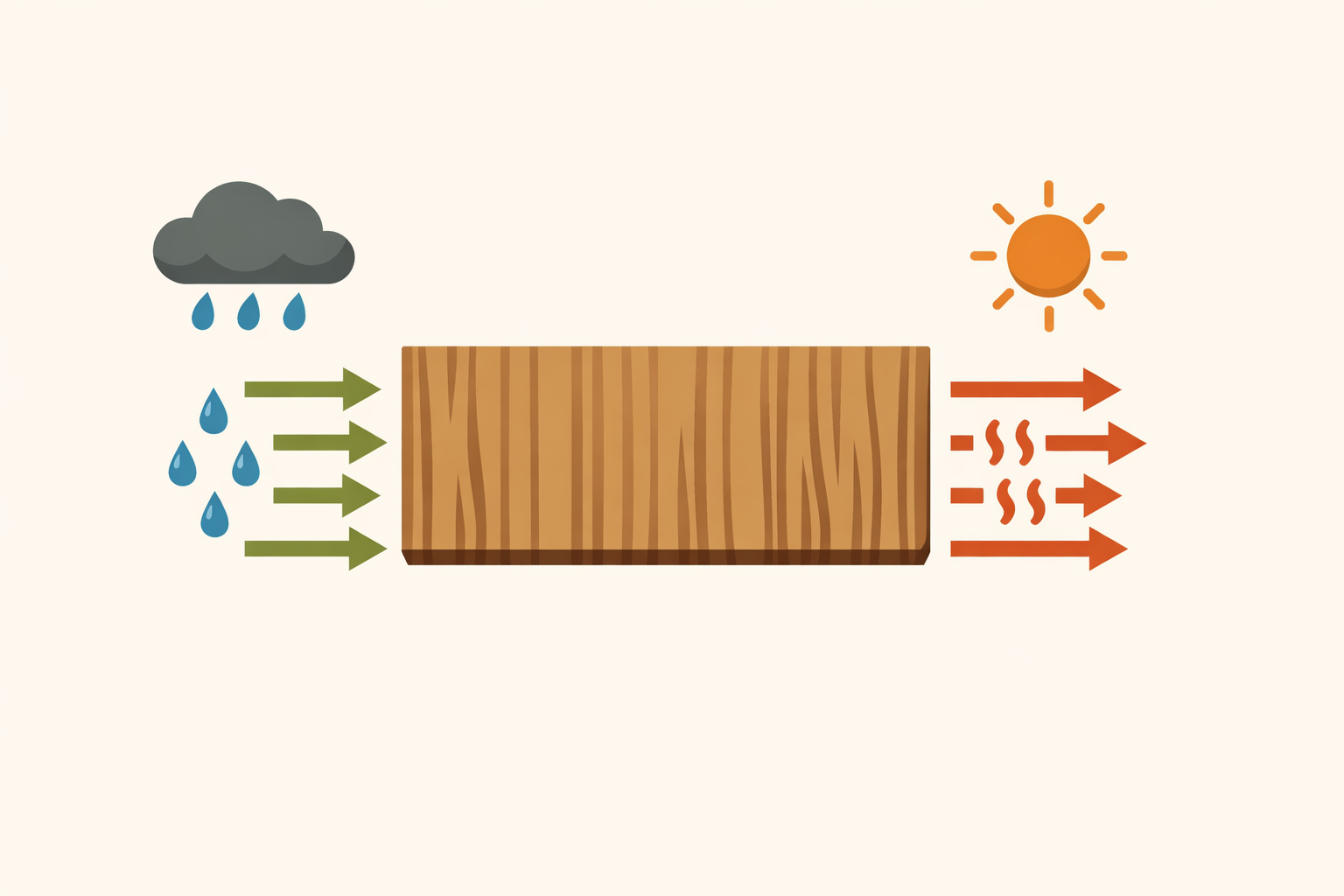
Wood is a living material. Even after it's been cut and dried, it continues to absorb and release moisture depending on its surroundings. Think of it as a slow sponge: if the air is humid, it takes in water; if it's dry, it lets it go. This causes swelling, shrinkage, warping or cracking.
Three key concepts (and nothing more)
Moisture Content (MC) — This is the percentage of water in the wood relative to its dry weight. Freshly cut green wood can have an MC of 40–80%. For lutherie, we need between 6% and 10%, ideally around 7–8%.
Relative Humidity (RH) — This is the percentage of moisture in the air. It's measured with a hygrometer. For a lutherie workshop, the ideal range is between 40% and 55% RH.
Equilibrium Moisture Content (EMC) — This is the point where the wood stops absorbing or releasing moisture because it's in balance with the surrounding air. If you keep your workshop at 45% RH, the wood will stabilise at around 8% MC. That's exactly what we're after.
Reference table: ambient RH → wood MC
| Ambient RH | Wood MC | Suitable for lutherie? |
|---|---|---|
| 20–30% | 4–6% | Too dry — risk of cracking |
| 30–40% | 6–8% | Acceptable — lower end |
| 40–55% | 7–10% | IDEAL for lutherie |
| 55–65% | 10–12% | Too humid — risk of warping |
| 65–80% | 12–16% | Dangerous — mould, severe warping |
Approximate values. Exact figures vary by species and temperature.
The golden rule
If you can only remember one number: 45% relative humidity. Keep your workshop as close to that value as possible and your wood will be happy. A room hygrometer is the most cost-effective investment you'll make.
Why is this so critical in lutherie?
A spruce soundboard is between 2 and 3 mm thick. At that thinness, any change in humidity causes movement. If the wood isn't stabilised at the right MC before building, the instrument can develop soundboard cracks, neck distortion, bridge lift or unpredictable tonal shifts. Proper drying isn't a luxury — it's the first step in a solid build.
Temperature matters too
Relative humidity and temperature go hand in hand. Warm air can hold more moisture than cold air, so when you heat a room in winter without adding moisture, RH drops. And when summer heat rises without ventilation, RH can spike. The ideal temperature range for a lutherie workshop is 18–24 °C (64–75 °F). Avoid peaks above 30 °C (resins can activate) and below 10 °C (condensation risk).
Acclimatisation: the step many forget
When you receive new wood — regardless of where it comes from — don't work it the same day. Leave it in your workshop, out of the box or packaging, for 1 to 2 weeks to adapt to the RH and temperature of your space. Wood needs time to reach equilibrium with its new environment. If you work it before acclimatisation, it can shift after gluing and ruin the build.
Essential tools
You don't need much. With these tools you can control the entire process. We've ranked them from most essential to recommended.
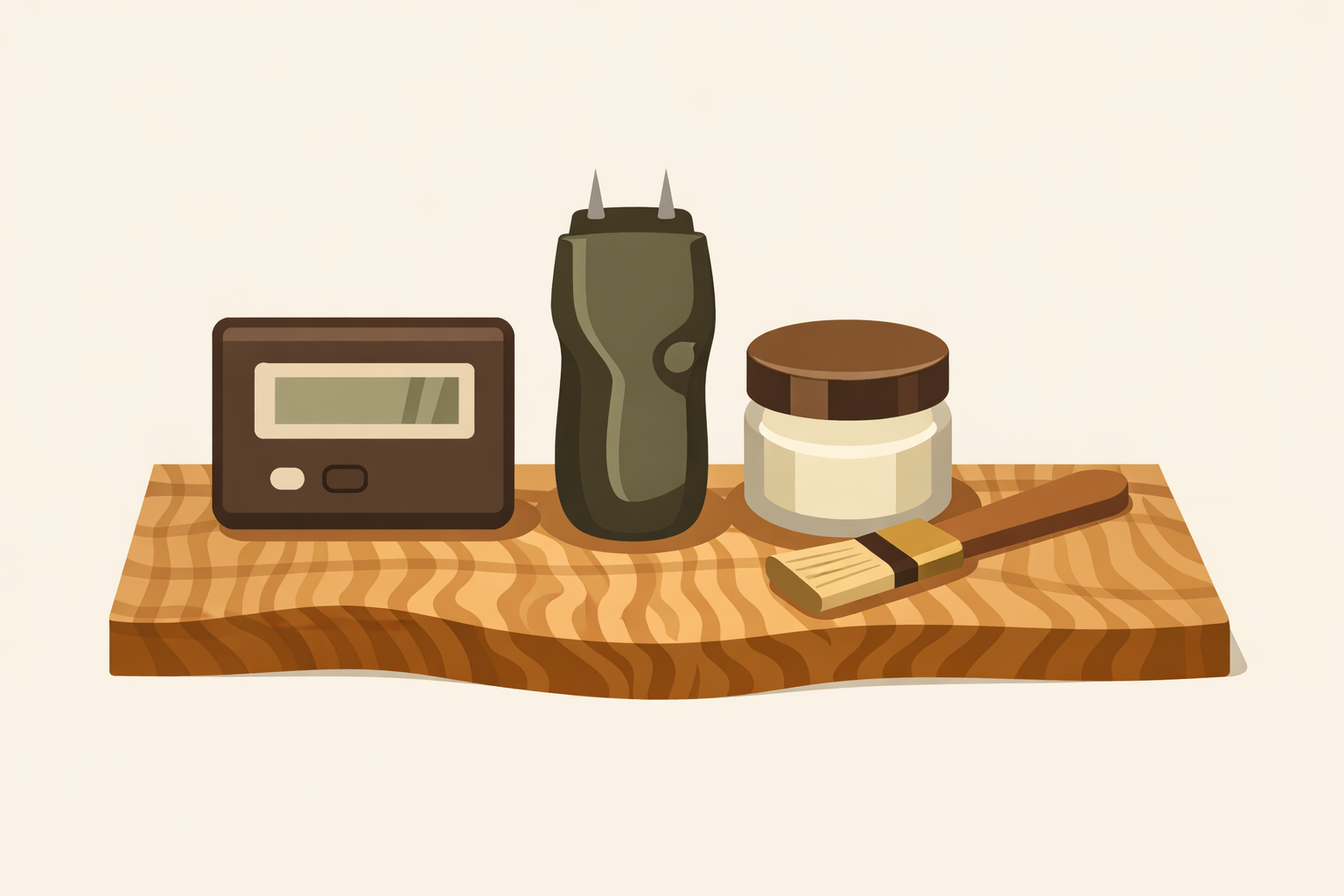
1
Digital room hygrometer
Measures the relative humidity of the air. Place it in your storage area at the same height as your wood (not on the wall next to a window). Models with max/min recording are ideal for tracking overnight fluctuations. If you only buy one tool, make it this one. You can browse the hygrometers and meters available in our catalogue.
2
Pin-type wood moisture meter
Two pins are pushed into the wood and give you the MC reading directly. It's the most reliable and affordable method for rough-sawn wood. The pins leave two tiny holes, so measure in areas you'll trim off later or on the edges.
3
End-grain sealer (paraffin wax, PVA glue or dedicated sealer)
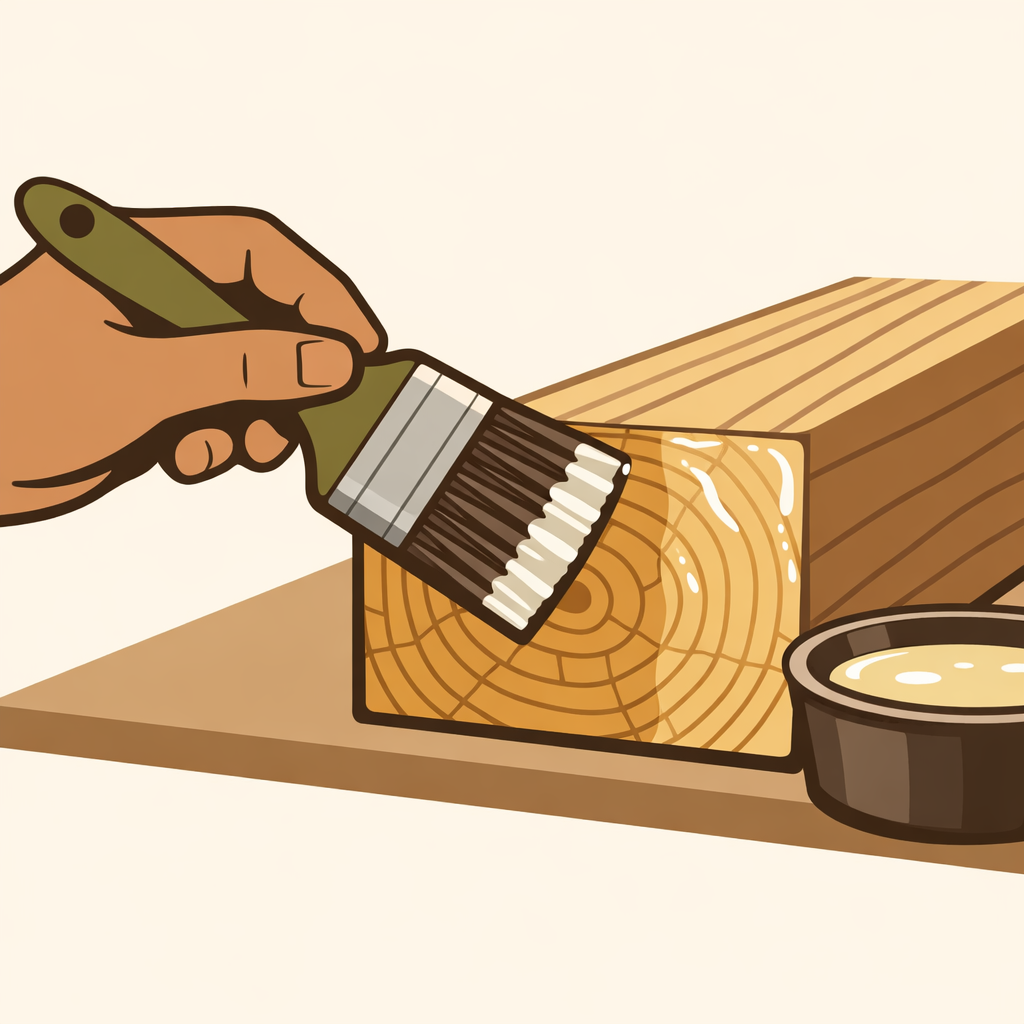
Wood loses moisture 10 times faster through the end grain than through the face. Sealing the ends with melted paraffin wax, diluted PVA glue or a commercial end-grain sealer prevents uneven drying and the dreaded end-grain checks. It's the cheapest and most effective solution available.
4
Good ventilation (and common sense)
A space with natural air circulation or a simple household fan does more for your wood than any expensive equipment. The goal is to renew the air without strong direct draughts on the pieces. If your space is very humid (basement, garage) or very dry (heated in winter), a dehumidifier or humidifier is recommended but not essential if you have good ventilation and monitor RH with your hygrometer.
ℹ️ Pin-type or pinless meter?
Pinless (induction) meters are more expensive and leave no mark, but they're less accurate on very dense woods like ebony or rosewood. For lutherie, the pin-type is more reliable and affordable. A pinless meter is a good complement if you work with finished pieces or thin veneers.
Drying step by step
Depending on where you buy and the type of piece, wood can arrive at different moisture levels. Some pieces come ready to work; others need a drying or stabilisation process before use. There are also situations where you'll need to recondition wood: if you buy green wood from a local sawmill, if you receive pieces after a long container voyage, or if your stock has been stored in an overly humid environment.
Method 1: Air drying (the classic)
This is the simplest method and the one that best preserves the acoustic properties of the wood. It requires no special equipment, but it does take patience.
1. Prepare the area. Find a covered, ventilated space protected from direct sunlight. A garage with ventilation, a shed or a room with a window will do. Avoid unventilated basements and attics where summer heat is extreme.
2. Stack correctly. Place stickers (dry wood strips of 15–20 mm) between each piece. The stickers must be perfectly aligned vertically, one above the other. This allows air to circulate across all faces evenly.
3. Seal the end grain. Before stacking, apply sealer to the cut ends. Wood loses moisture 10–12 times faster through the end grain than through the side faces. Without sealing, drying will be uneven and checks will appear.
4. Add weight on top. Place an evenly distributed weight on the pile (another thick board, bricks...). This counteracts the wood's tendency to warp during drying.
5. Measure and wait. Check the MC every 2–4 weeks with your pin meter. The general rule: 1 year of air drying per 25 mm (1 inch) of thickness. A guitar soundboard (3 mm) dries much faster, but let it stabilise for several weeks regardless.
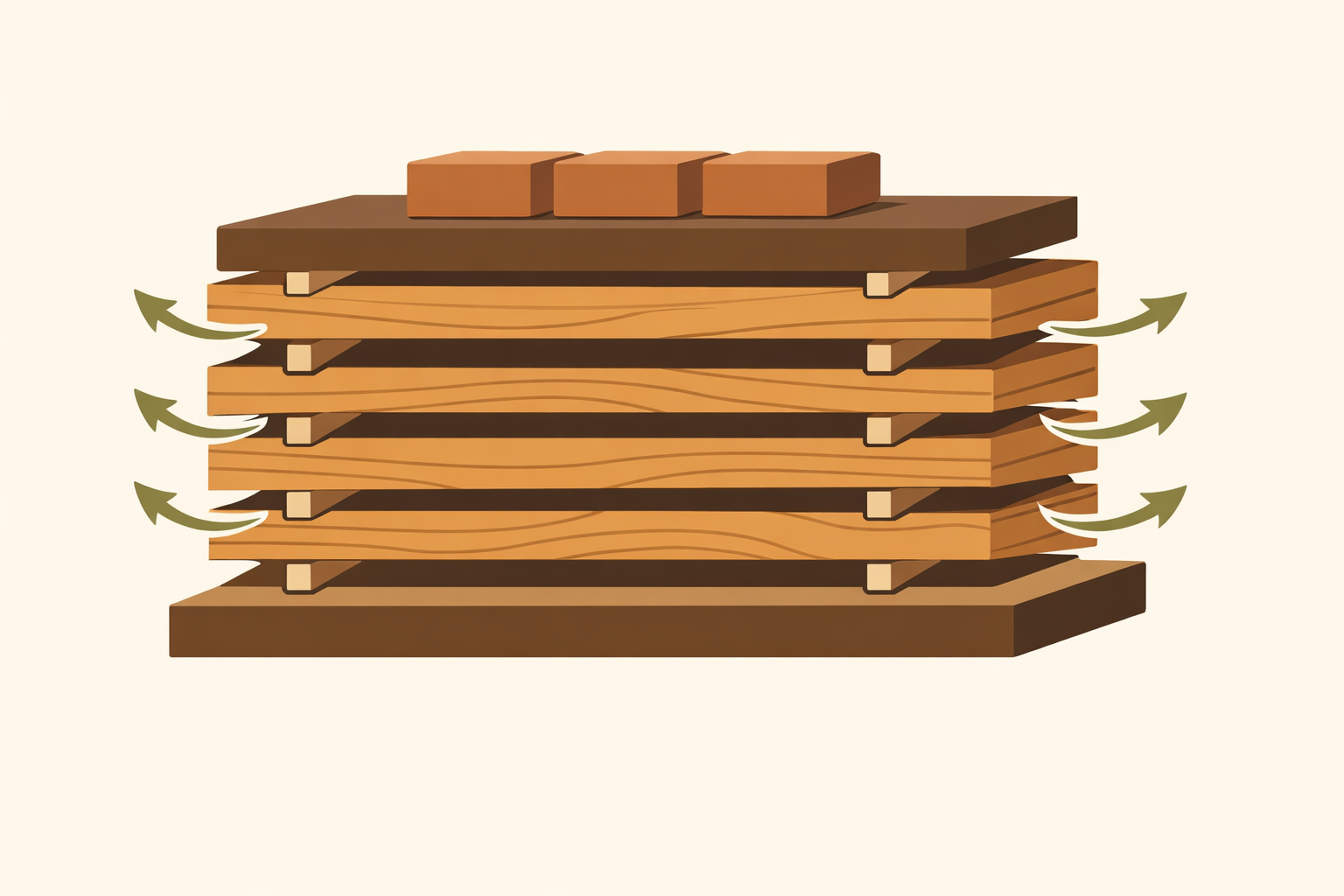
Correct stacking: solid base, aligned stickers between layers, weight distributed on top.
Method 2: Accelerated drying in a small space
If you don't have outdoor space or you live in a humid climate, you can create a "mini drying chamber" with items you already have at home.

- A cupboard or small room — The smaller the space, the easier it is to control humidity.
- A small fan — Creates gentle circulation. Don't point it directly at the wood; the airflow should be indirect.
- Silica gel or coarse salt — In open containers inside the space, they help absorb excess moisture passively.
- If possible, a dehumidifier — Not essential, but in very humid areas (basements, uninsulated garages) it speeds things up considerably. Set it to 40–45% RH if you use one.
- Stack as for air drying — Stickers, end-grain sealing, weight on top.
⚠️ Watch the speed
Drying too fast is just as bad as not drying at all. Aggressive drying (strong heat or dehumidifier at minimum setting) creates internal stresses that cause checks and cell collapse. The rule: never drop the ambient RH below 35% suddenly. Decrease gradually, 5% per week.
Approximate air-drying times
These times are approximate for air drying in favourable conditions (covered, ventilated, 40–55% RH, 18–25 °C). Accelerated drying with a dehumidifier can reduce them by 30–50%.
| Piece type | Thickness | Approx. time | Notes |
|---|---|---|---|
| Soundboard (spruce, cedar) | 3–4 mm | 2–6 weeks | Usually arrives dry. Stabilise it. |
| Back/sides (rosewood) | 3–5 mm | 4–8 weeks | Denser = slower. Seal the ends. |
| Back/sides (maple, mahogany) | 3–5 mm | 3–6 weeks | Maple stains easily if RH is excessive. |
| Neck (mahogany, cedar, maple) | 25–30 mm | 6–12 months | Critical. A poorly dried neck will twist. |
| Fretboard (ebony, rosewood) | 8–10 mm | 2–4 months | Very dense woods. Dry slowly. |
| Bridge/nut (ebony, rosewood) | 10–15 mm | 2–4 months | Small pieces. Risk of checks if forced. |
| Violin/viola plate | 15–20 mm | 4–8 months | Spruce for violin tops needs years of maturation. |
Times assume semi-dry wood (MC 15–20%). Green wood (MC 40%+) may need double or more.
Warning signs during drying
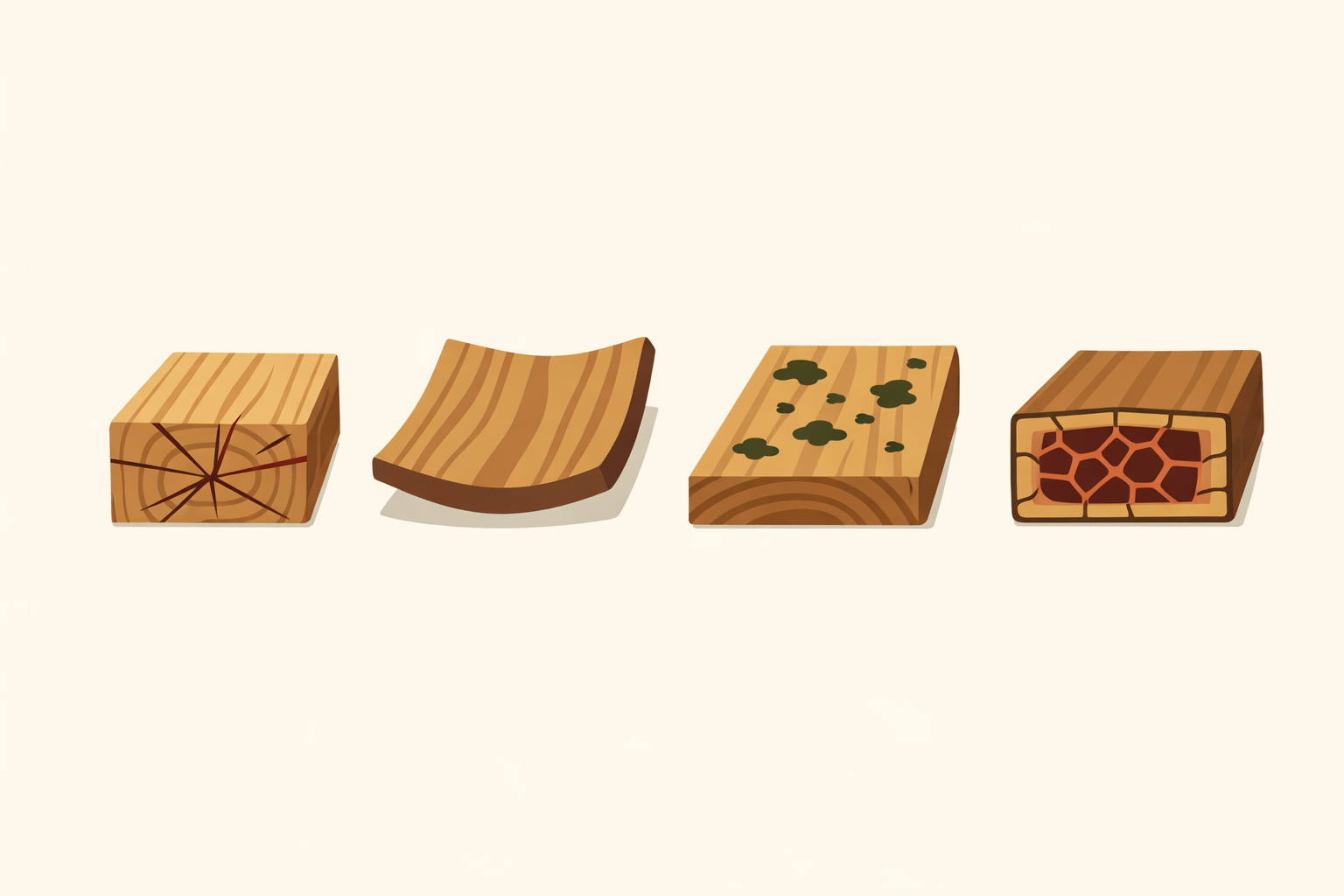
Left to right: end checks, cupping, mould, internal collapse (honeycomb).
- End checks: The end grain dries faster than the core. A sign that sealer is missing or the environment is too dry.
- Cupping: The piece curves into a channel shape. One face is drying faster than the other. Check that stickers are properly placed and flip the piece.
- Dark or greenish spots: Mould. Too much humidity and not enough ventilation. Remove the piece, clean it with diluted hydrogen peroxide and improve air circulation.
- Internal checks (honeycomb): The surface dried too fast and internal tension ruptured the fibres. This is irreversible. A sign of overly aggressive drying.
Storage: keeping your wood safe
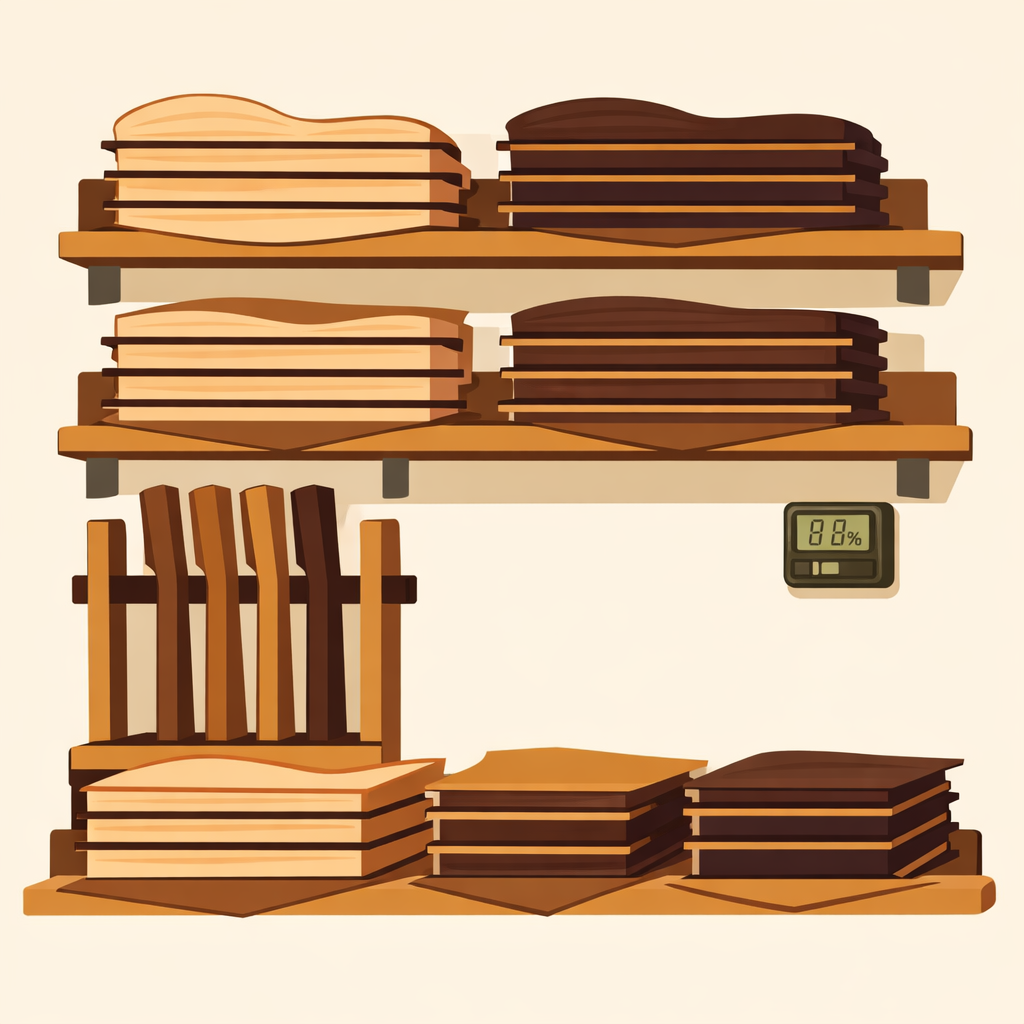
Drying the wood properly is only half the job. If you then store it badly, everything you've gained is lost. Here's how to organise your storage space, even if it's small.
Horizontal or vertical?
Horizontal whenever possible. Soundboards, backs and sides should be stored flat, separated by thin stickers (5–10 mm) with evenly distributed weight on top. This keeps the piece flat and prevents warping.
Vertical only for necks and long pieces that don't fit horizontally. In that case, support them at two points minimum (never just one end) and make sure they don't sag under their own weight.
End-grain protection
Even if the wood is already dry, it's still good practice to keep the ends protected. A bit of paraffin wax, end-grain sealer or even thick masking tape reduces rapid moisture exchange through the ends and prevents micro-checks during seasonal changes.
Humidity control in the storage area
Your goal is to keep RH between 40% and 55%, stable. Sudden fluctuations are worse than an RH slightly out of range but constant. Here are some strategies:
- Cross ventilation: If you can open two air-entry points in your storage space, you create natural circulation at no cost. A small household fan is a good supplement when there's no breeze.
- Coarse salt or silica gel: In open containers inside closed shelving or cabinets. They absorb excess humidity passively. Replace the salt when it clumps.
- In winter with heating: Warm air is dry air. If you drop below 35% RH, place water containers near the heat source or use an evaporative humidifier (cheap and quiet).
- In humid summers: Ventilation is your first line of defence. If your area consistently exceeds 70% RH, a dehumidifier with a hygrostat is the most effective solution (set it to 45% and let it work on its own).
The most important thing: stability
A constant RH of 50% is better than one that swings between 35% and 55%. Sudden fluctuations are your wood's worst enemy. Whatever your method (ventilation, salt, dehumidifier), always aim for consistency.
Separating species
Some woods contain resins or oils that can migrate to neighbouring pieces. Rosewood, for example, is known for releasing oils that stain light-coloured woods like maple or spruce. Always separate dark, oily woods from light ones. A simple sheet of brown paper between groups does the job.
Stock rotation
If you buy wood regularly, use the FIFO system: first in, first out. Label each piece with the purchase date. The wood that's been in your stock the longest is the most stabilised and the one you should use first.
Monthly storage check
Set aside 15 minutes a month to inspect your wood. This checklist will guide you:
- ☐ Check hygrometer reading (range: 40–55% RH)
- ☐ Visually inspect tops and thin pieces: any new warping?
- ☐ Check end grain: any starting checks? Reapply sealer if needed
- ☐ Check stickers: still aligned? Is the weight still evenly distributed?
- ☐ Look for mould spots, especially in poorly ventilated areas
- ☐ Empty the dehumidifier tank (or check the drain)
- ☐ Confirm dark woods aren't touching light woods
- ☐ Record the date and RH reading in a notebook or app
Maderas Barber tip
If you'd rather not deal with drying yourself, at Maderas Barber we offer a professional vacuum drying service to bring your wood to the optimal MC for lutherie. Whatever the origin of your pieces, proper storage afterwards is the insurance for your investment.
10 mistakes that ruin your wood
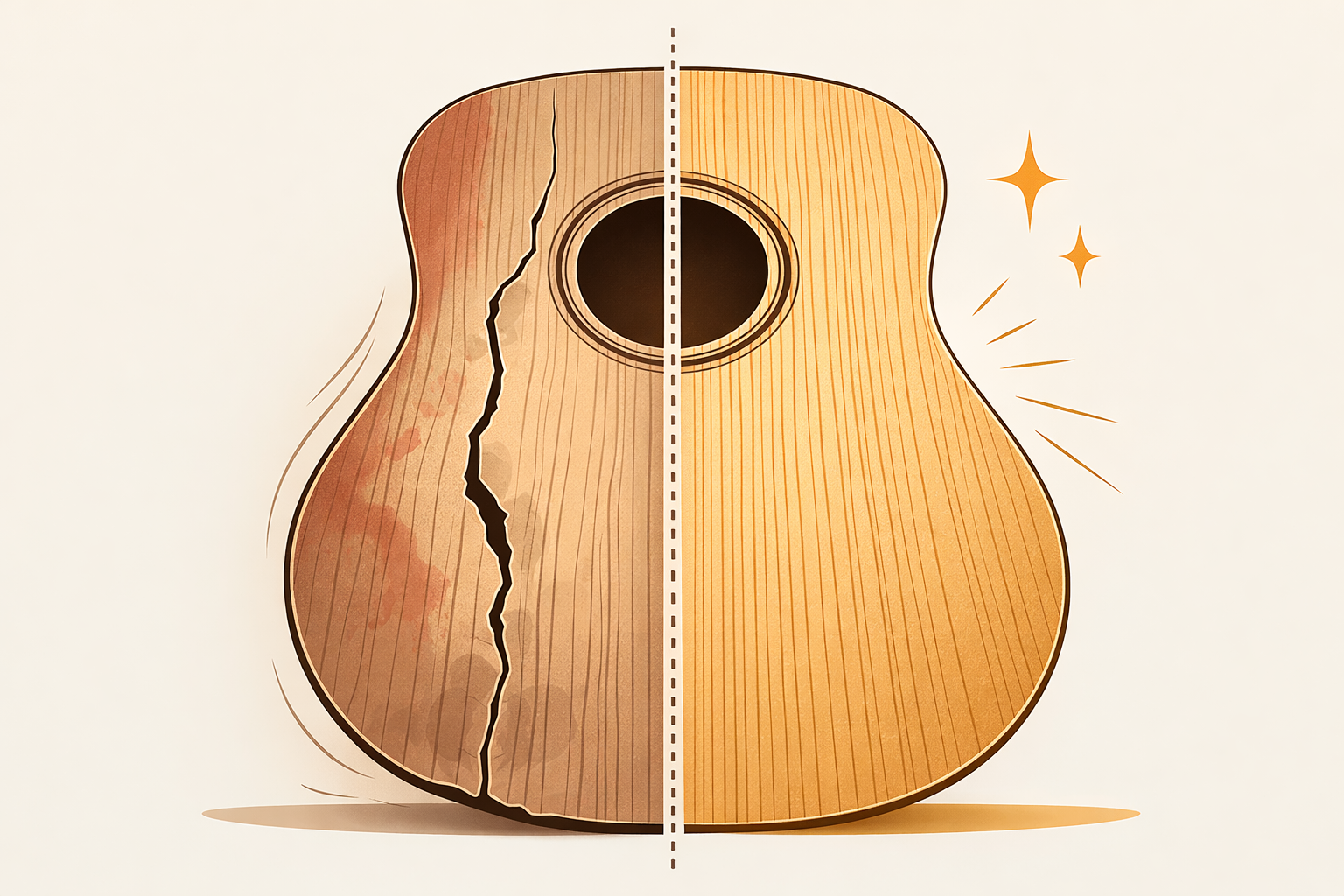
1Leaving wood in the car
In summer, a closed car can exceed 60 °C (140 °F). In winter, moisture condenses as it cools. Both extremes are disastrous. Take the wood out of the car as soon as you arrive.
2Not sealing the end grain
This is the most common mistake and the easiest to avoid. Unsealed ends lose moisture 10 times faster. Result: guaranteed end-grain checks.
3Leaning soundboards against the wall
A soundboard propped vertically against a damp or cold wall will warp within weeks. Always store flat with stickers and weight.
4Storing in an uninsulated garage
Garages swing between 10 °C and 40 °C across the seasons. Without insulation or RH control, your wood goes through a constant cycle of swelling and shrinking.
5Mixing green wood with dry wood
Green wood releases moisture that your dry pieces absorb. Always separate them in different zones.
6Cranking the heating up in winter
Heating drops RH dramatically. A workshop at 25 °C without a humidifier can fall below 25% RH. At those levels, cracking is inevitable.
7Trusting "it looks dry" without measuring
Wood can look dry on the surface and be at 18% MC inside. Only the pin meter tells the truth. Always measure.
8Stacking without stickers
Without stickers, air can't circulate between pieces. The faces in contact retain moisture unevenly: mould, staining and irregular drying.
9Ignoring seasonal changes
RH drops in winter (heating) and rises in summer (heat + humidity). Adjust your dehumidifier or humidifier with the seasons. Two checks a year minimum: October and April.
10Buying cheap wood "to practise" and drying it yourself
Properly drying green wood takes years and a lot of space. If you need dry wood and can't wait, find a supplier that offers pre-stabilised stock or a professional drying service (like vacuum drying). Your time and your instrument will thank you.
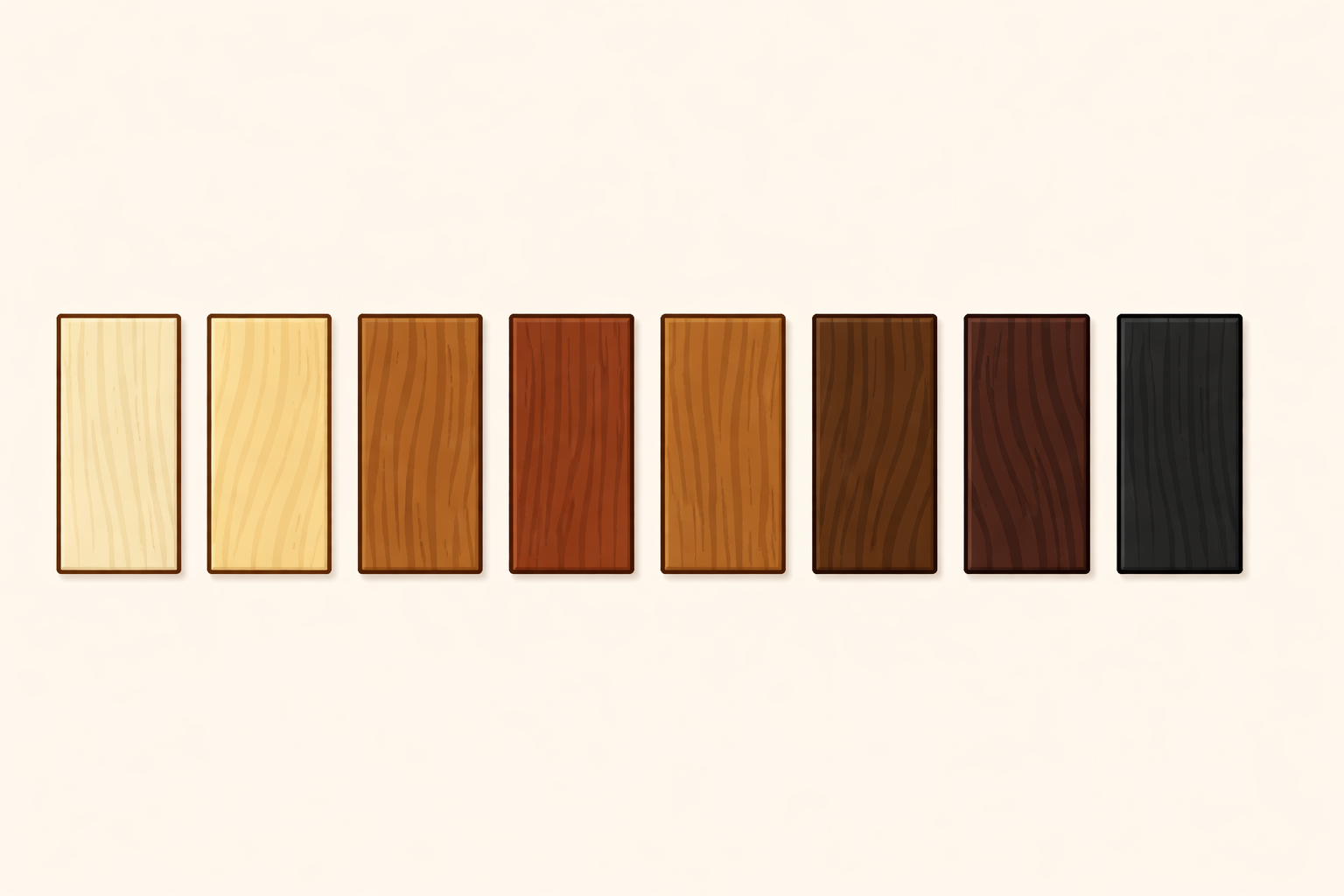
Quick reference table by species
Keep this table handy. The ideal MC and movement sensitivity values will help you prioritise which woods need the most attention in your storage. To learn more about each species, visit our complete tonewood guide.
| Species | Primary use | Ideal MC | Sensit. | Notes |
|---|---|---|---|---|
| Sitka Spruce | Soundboard | 6–8% | ●●●○ | Very sensitive to RH. Keep stable. |
| European Spruce | Soundboard | 6–8% | ●●●○ | Ideal for classical/violin. Fragile. |
| Western Red Cedar | Soundboard | 7–9% | ●●○○ | More tolerant than spruce. Watch for resins. |
| Rosewood (Dalbergia) | Back/sides | 7–9% | ●●○○ | Dense. Oils can stain. CITES. |
| Mahogany (Swietenia) | Back/neck | 7–9% | ●○○○ | Stable. Good behaviour. |
| African Mahogany (Khaya) | Back/neck | 7–9% | ●○○○ | Similar to Swietenia. More available. |
| Maple (Acer) | Back/neck | 6–8% | ●●●○ | Stains easily with moisture. Be careful. |
| Ebony (Diospyros) | Fretboard | 7–9% | ●●○○ | Very dense. Dries slowly. End checks. |
| Cypress | Back (flamenco) | 7–9% | ●●○○ | Aromatic. Store separately. |
| Walnut | Back/sides | 7–9% | ●●○○ | Good weight-to-stiffness ratio. |
| Sapele | Back/neck | 7–9% | ●○○○ | Very stable. Good mahogany alternative. |
| Ovangkol | Back/sides | 7–9% | ●○○○ | Dense and stable. Easy to store. |
| Ziricote | Back/sides | 7–9% | ●●○○ | Oils similar to rosewood. Store separately. |
| Koa | Top/back | 7–9% | ●●●○ | Highly reactive to RH. Store with care. |
| Cocobolo | Fretboard/bridge | 7–9% | ●○○○ | Aggressive oils. Always store separately. CITES. |
Movement sensitivity: ●○○○ = very stable, ●●●● = highly reactive. CITES = regulated species, requires documentation for international trade.
ℹ️ About CITES-listed woods
Some of the most prized species in lutherie (rosewood, cocobolo) are regulated under the CITES convention. At Maderas Barber, all our CITES wood comes with the corresponding legal documentation. More information: maderasbarber.com
Is your workshop ready?
Use this list to assess whether your workspace is ready to receive and preserve tonal wood. Tick off each point you've already sorted.
MEASURE
☐ I have a room hygrometer in the storage area
☐ I have a wood MC meter (pin-type or pinless)
☐ I keep a log of RH readings (notebook or app)
STORE
☐ My soundboards and backs are stored flat with stickers
☐ End grain is sealed (wax, sealer or tape)
☐ Dark woods are separated from light woods
☐ There's distributed weight on piles of thin stock
CONTROL
☐ RH stays between 40% and 55%
☐ I've assessed whether I need a dehumidifier or humidifier for my area
☐ I do a monthly visual inspection of my wood
☐ I adjust RH control with seasonal changes
PROTECT
☐ My storage area is covered and ventilated
☐ No direct sunlight hits the wood
☐ New wood is acclimatised before being worked
Well-cared-for wood is the first step towards an instrument that sounds the way it should. You don't need expensive equipment or huge spaces — just attention, consistency and clear thinking.
Looking for tonewood ready to work?
At Maderas Barber you'll find soundboards, backs, sides, necks and fretboards from over 90 species for lutherie. FSC certified wood available. And if you need professional drying, ask about our vacuum drying service.
© 2025 Maderas Barber. This guide is free to share. If you pass it on, we appreciate it.
Comments (0)
No comments at this moment
