

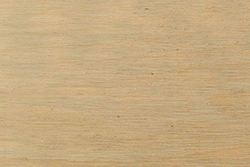
↻
Birch
Betula pendula
Carving
Turning
Birch
OriginEurope
DescriptionIts density is 640-670 kg/m³.
PropertiesIt holds up well to bending when air-dried, with a medium hardness.
UseGreat for carving and turning.
See full details →

↻
Phenolic Birch
Betula pendula
Plywood
Phenolic Birch
OriginEurope
DescriptionIts density is 670 kg/m³.
PropertiesMachines easily, though it tends to leave a bit of fuzz along the fibers.
UsePlywood panels.
See full details →

↻
Spalted Birch
Betula pendula
Turning
Carving
Knife handles
Spalted Birch
OriginEurope
DescriptionIts density is 640-670 kg/m³.
PropertiesIt holds up well to bending when air-dried, with a medium hardness.
UseGreat for turning, carving and knife handles.
See full details →

↻
European Spruce
Picea abies
Soundboard
European Spruce
OriginGermany, Romania
DescriptionIts density is 450 kg/m³.
PropertiesStains very easily — keep it away from damp storage.
UseSoundboards for stringed instruments, especially classical guitar, violin and cello. Highly prized for its tonal qualities.
See full details →

↻
Abete di Engelmann
Picea engelmannii
Tavola armonica
Economico
Abete di Engelmann
OrigineCanada
DescrizioneLegno chiaro con una densità di 350-410 kg/m³.
CaratteristicheSi macchia con grande facilità: evita di conservarlo in ambienti umidi.
UtilizzoTavole armoniche per strumenti a corda. Grazie al costo più contenuto e a caratteristiche simili, viene spesso impiegato come alternativa all'Abete Europeo.
Vedi scheda completa →
↻
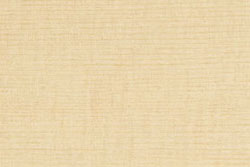
Sitka Spruce
Picea sitchensis
Soundboard
Acoustic
Sitka Spruce
OriginCanada
DescriptionIts density is 400-450 kg/m³.
PropertiesSensitive to moisture and prone to staining.
UseSoundboards for stringed instruments, especially acoustic guitar. The trunks reach a generous diameter, large enough even for double bass tops.
See full details →
↻
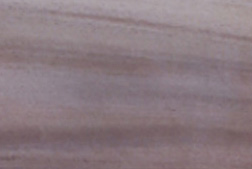
Acacia
Acacia melanoxylon
Turning
Furniture
Acacia
OriginAfrica, Asia or South America
DescriptionDensity 640 kg/m³. Its colour ranges from yellow to brown.
PropertiesThe straight grain makes it easier to work, though its hardness pushes back.
UseTurning, indoor and outdoor furniture, flooring, decking, and more.
See full details →
↻
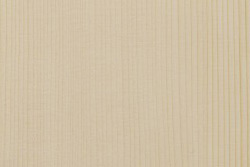
Adirondack
Picea rubens
Soundboard
Joinery
Adirondack
OriginNorthwestern USA and Eastern Canada
DescriptionDensity 400-500 kg/m³.
PropertiesMachines easily overall, though knots can occasionally give you trouble.
UseSoundboards for musical instruments, interior joinery and cabinetmaking.
See full details →
↻
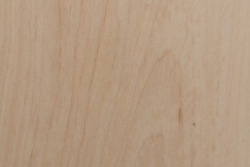
Alder
Alnus glutinosa
Electric guitar body
Bass
Alder
OriginEurope
DescriptionDensity of 500-550 kg/m³.
PropertiesMachines without issue, though it's best to keep your tools nice and sharp.
UseMainly used for electric guitar and bass bodies.
See full details →
↻
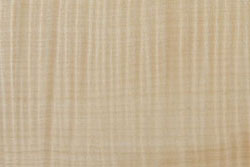
Maple
Acer pseudoplatanus
Back and sides
Necks
Electric guitar body
Maple
OriginGermany, Romania
DescriptionIts density is 610-680 kg/m³.
PropertiesStains very easily — keep it away from damp storage.
UseBack, sides and neck for violin, viola, cello and double bass. Body for classical and acoustic guitar. Neck and body for electric guitar and bass.
See full details →
↻
Birdseye Maple
Acer saccharum
Back and sides
Electric guitar body
Birdseye Maple
OriginNorth America
DescriptionA pale wood with a density of 630-700 kg/m³.
PropertiesTough to saw, tricky to machine, and a real challenge to sand.
UseMainly used for soundboards and bodies of electric guitars and basses.
See full details →
↻
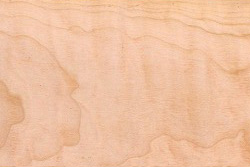
Quilted Maple
Acer saccharum
Electric guitar body
Drop top
Quilted Maple
OriginNorth America
DescriptionA pale wood with a density of 630-700 kg/m³.
PropertiesTough to saw, tricky to machine, and a real challenge to sand.
UseMainly used as drop tops on electric guitar and bass bodies.
See full details →
↻
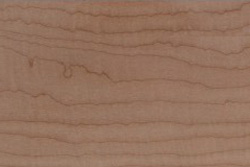
American Curly Maple
Acer saccharum
Electric guitar body
Drop top
American Curly Maple
OriginNorth America
DescriptionA pale wood with a density of 630-700 kg/m³.
PropertiesTough to saw, tricky to machine, and a real challenge to sand.
UseMainly used as drop tops on electric guitar and bass bodies.
See full details →
↻
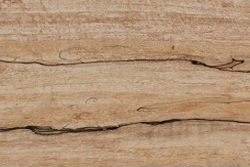
Spalted Maple
Acer saccharum
Electric guitar body
Drop top
Spalted Maple
OriginNorth America
DescriptionA pale wood with a density of 630-700 kg/m³.
PropertiesTough to saw, tricky to machine, and a real challenge to sand.
UseMainly used for electric guitar and bass bodies.
See full details →
↻
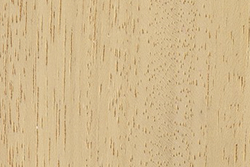
Ayous
Triplochiton scleroxylon
Bracing
Kerfings
Ayous
OriginEast and Central Africa
DescriptionA pale wood with a density of 380 kg/m³.
PropertiesEasy to work overall. It carves, stains, glues and finishes nicely.
UseMainly used for instrument bracing, also known as linings or kerfings.
See full details →
↻
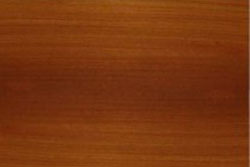
Bloodwood
Brosimum paraense
Back and sides
Bloodwood
OriginBrazil
DescriptionA red-coloured wood with a density of 1050 kg/m³.
UseGuitar back and sides.
See full details →

↻
Bocote
Cordia eleagnoides
Fretboard
Bridge
Headstock
Bocote
OriginMexico
DescriptionIts density is 950-1200 kg/m³.
PropertiesEasy to work and takes glue well.
UseUsed for fretboards, and also for the body, headstock and bridge of classical and acoustic guitars.
See full details →
↻
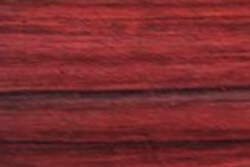
Bois de Rose
Dalbergia maritima
Back and sides
Woodwind
Carving
Bois de Rose
OriginMadagascar
DescriptionDensity of 930 kg/m³.
PropertiesAvoid oil finishes unless you want the wood to darken to an almost-black tone. Species protected under CITES Appendix II.
UseGuitar backs and woodwind instruments. Turning and carving.
See full details →
↻
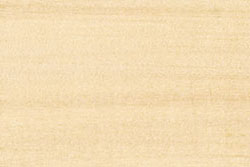
Boxwood
Buxus sempervirens
Woodwind
Boxwood
OriginSpain
DescriptionA pale wood with a density of 900-1030 kg/m³.
PropertiesSensitive to moisture and prone to staining.
UseWoodwind instruments.
See full details →
↻
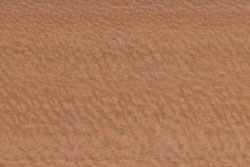
Brazilian Lacewood
Roupala brasiliensis
Back and sides
Flamenco cajón
Brazilian Lacewood
OriginTropical South America
DescriptionDensity of 885 kg/m³.
PropertiesMachines without issue, and glues and finishes just as easily.
UseUsed as veneer for back and sides and for flamenco cajones.
See full details →
↻
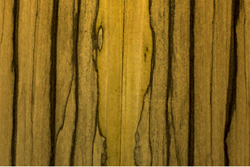
Brown Ebony
Sapium glandulosum
Guitar body
Brown Ebony
OriginArgentina
DescriptionA light brown wood with dark veining and a density of 950 kg/m³.
PropertiesStriking aesthetic qualities.
UseGuitar body.
See full details →
↻
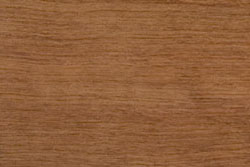
Bubinga
Guibourtia spp.
Guitar body
Woodwind
Percussion
Bubinga
OriginGabon
DescriptionA reddish-toned wood with a density of 700-900 kg/m³.
PropertiesTough and stable. Species protected under CITES Appendix II since 2017 — international trade requires a certificate.
UseGuitar body, woodwind and percussion instruments.
See full details →

↻
Campinceran
Dalbergia granadillo Pitt.
Fretboard
Campinceran
OriginMexico
DescriptionA brown-coloured wood with a density of 990-1250 kg/m³.
PropertiesHigh natural oil content. Species protected under CITES Appendix II.
UseUsed for fretboards and also for woodwind instruments.
See full details →
↻
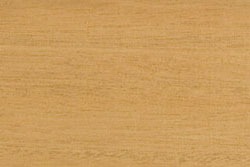
Mahogany
Swietenia macrophylla
Necks
Guitar body
Electric guitar body
Mahogany
OriginBrazil
DescriptionA reddish-brown wood with a density of 490-530 kg/m³.
PropertiesProtected species, listed under CITES Appendix II.
UseNecks for all kinds of guitar, especially acoustic. Guitar body. Body for electric guitar and bass.
See full details →
↻
Fiji Mahogany
Swietenia macrophylla
Necks
Guitar body
Electric guitar body
Fiji Mahogany
OriginFiji
DescriptionIts density is 490-530 kg/m³.
PropertiesNot protected under CITES thanks to its origin. No export certificate required.
UseNecks for all kinds of guitar, especially acoustic. Guitar body. Body for electric guitar and bass.
See full details →

↻
Honduras Cedar
Cedrela odorata
Necks
Honduras Cedar
OriginBrazil
DescriptionA light brown wood with a density of 450-600 kg/m³.
PropertiesSpecies protected under CITES Appendix II.
UseNecks for stringed instruments, especially classical guitar.
See full details →
↻
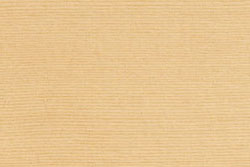
Western Red Cedar
Thuja plicata
Soundboard
Classical
Western Red Cedar
OriginCanada
DescriptionA reddish-toned wood with a density of 350-400 kg/m³.
PropertiesCan crack when bent.
UseSoundboards for classical and acoustic guitar. Its tonal qualities are highly prized.
See full details →

↻
Cherry
Prunus avium
Turning
Pens
Cherry
OriginEurope
DescriptionDensity of 610-630 kg/m³. The heartwood is a pale pink-brown.
PropertiesEasy to work.
UseWidely used for turning, pens and bowls.
See full details →
↻
Poplar
Populus alba
Electric guitar body
Joinery
Poplar
OriginSpain
DescriptionDensity of 480 kg/m³. The wood is pale yellow or yellowish-white.
PropertiesEasy to saw and machines without any trouble.
UseMusical instruments, matches, packaging and crates.
See full details →
↻
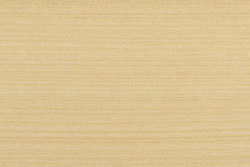
Cypress
Cupressus sempervirens
Back and sides
Flamenco
Cypress
OriginSpain
DescriptionA white wood with yellow undertones and a density of 400-600 kg/m³.
PropertiesCan stain in humid environments.
UseBody for classical guitar, especially flamenco.
See full details →
↻
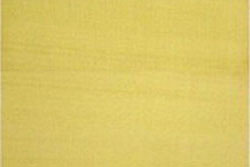
Victory Island Cypress
Cupressus nootkatensis
Soundboard
Back and sides
Victory Island Cypress
OriginCanada
DescriptionA yellow-toned wood with a density of 350-400 kg/m³.
UseTops, backs and sides.
See full details →
↻
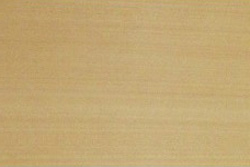
South American Cypress
Cupressus sempervirens
Back and sides
Flamenco
South American Cypress
OriginSouth America
DescriptionA pale wood with a density of 400-600 kg/m³.
PropertiesTricky to saw due to knots and uneven grain.
UseMainly used for back and sides of classical and flamenco guitars.
See full details →
↻
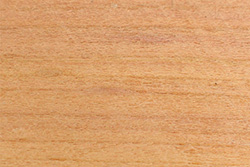
Plum
Prunus domestica
Turning
Cabinetmaking
Knife handles
Plum
OriginEurope
DescriptionA soft wood with a density of 610-630 kg/m³.
PropertiesThe clean, straight-grained sections are easy to work.
UseCabinetmaking, turning and knife handles.
See full details →
↻
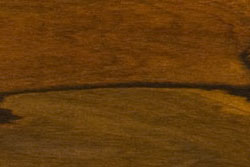
Cocobolo
Dalbergia retusa
Back and sides
Woodwind
Cocobolo
OriginMexico
DescriptionIts density is 990-1250 kg/m³.
PropertiesHigh natural oil content. Species protected under CITES Appendix II.
UseGuitar body. Woodwind instruments.
See full details →

↻
Curupay
Anadenanthera colubrina
Turning
Curupay
OriginSouth America
DescriptionDensity of 1000 kg/m³. The heartwood is a reddish brown.
PropertiesGenerally tough to work due to its irregular grain and high density.
UseGreat for turning.
See full details →
↻
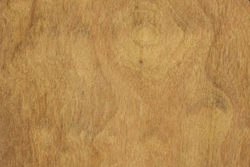
Dorado
Aniba perutilis
Back and sides
Drop top
Dorado
OriginSouth America (Colombia, Ecuador, Peru)
DescriptionDensity of 490-530 kg/m³.
PropertiesWorks well. Naturally smooth to the touch.
UseBack and sides for classical and acoustic guitars. Decorative drop tops for electric guitar and bass.
See full details →

↻
Ebony
Diospyros crassiflora
Fretboard
Woodwind
Ebony
OriginCameroon, Nigeria
DescriptionOne of the densest woods in the world, at 1000-1275 kg/m³.
PropertiesKeep it in a stable, controlled environment during storage and working.
UseFretboard for stringed instruments. Woodwind instruments.
See full details →

↻
Amara Ebony
Diospyros celebica
Back and sides
Amara Ebony
OriginAsia
DescriptionA very dense wood (1100-1300 kg/m³) with the characteristic streaking of Macassar Ebony.
PropertiesIts density and toughness call for powerful machinery and perfectly sharp tools.
UseGuitar body, mainly back and sides.
See full details →
↻
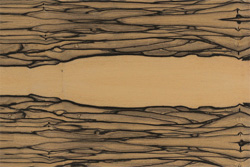
Pale Moon
Diospyros malabarica
Back and sides
Flamenco cajón
Pale Moon
OriginSoutheast Asia
DescriptionA striking wood with bold black streaks against a pale yellow background. Density of 825 kg/m³.
PropertiesMachines without issue. Takes glue and finish nicely.
UseVeneered pieces for back, sides and flamenco cajones.
See full details →
↻
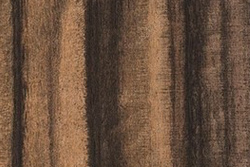
Exotic Ebony
Diospyros crassiflora
Fretboard
Woodwind
Exotic Ebony
OriginCameroon, Nigeria
DescriptionDensity of 1000-1275 kg/m³.
PropertiesCracks easily with shifts in temperature or relative humidity. Keep it in a stable, controlled environment.
UseFretboard for stringed instruments. Woodwind instruments.
See full details →
↻
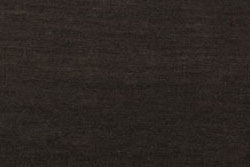
Madagascar Ebony
Diospyros spp.
Fretboard
Woodwind
Madagascar Ebony
OriginMadagascar
DescriptionAn extremely dense black wood, 1050-1280 kg/m³.
PropertiesCracks easily with shifts in temperature and humidity. Keep it in a stable environment.
UseFretboard for stringed instruments. Woodwind instruments.
See full details →
↻
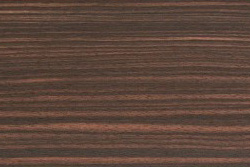
Macassar Ebony
Diospyros celebica
Back and sides
Fretboard
Macassar Ebony
OriginAsia
DescriptionVery high density (1000-1300 kg/m³) with the striped figure that Macassar is known for.
PropertiesWatch the humidity during storage to keep the wood from developing defects.
UseGuitar body and fretboards.
See full details →
↻
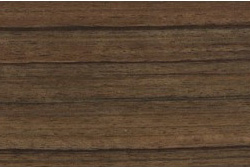
Malaysian Blackwood
Diospyros ebonasea
Back and sides
Fretboard
Malaysian Blackwood
OriginAsia
DescriptionExceptional density (1000-1300 kg/m³). Dark figure with brown, grey and greenish highlights.
PropertiesMay cause dermatitis. Store at a controlled temperature to prevent cracking.
UseBack and sides, fretboards, bridges and headstocks.
See full details →
↻
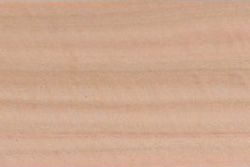
Curly Eucalyptus
Eucalyptus globulus
Back and sides
Curly
Curly Eucalyptus
OriginTasmania
DescriptionDensity 740-830 kg/m³. The curly variety offers a wavy figure that's beautifully decorative.
PropertiesStore somewhere free from sudden swings in temperature and humidity.
UseGuitar body: back and sides.
See full details →
↻
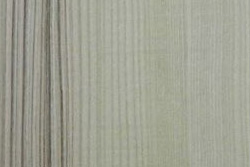
Ash
Fraxinus americana
Electric guitar body
Ash
OriginNorth America
DescriptionMedium density (660 kg/m³). A pale wood with pronounced grain.
PropertiesGlues and finishes well. Normal blade dulling during sawing.
UseElectric guitar bodies, tool handles, veneers and musical instruments.
See full details →
↻
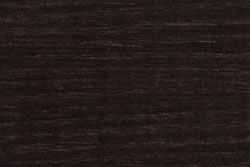
Blackwood
Dalbergia melanoxylon
Woodwind
Clarinet
Blackwood
OriginMozambique, Tanzania
DescriptionA black wood that ranks among the densest in the world (1250-1300 kg/m³).
PropertiesCan crack if not properly waxed.
UseWoodwind instruments (clarinet, oboe). Highly prized for its tonal quality.
See full details →
↻
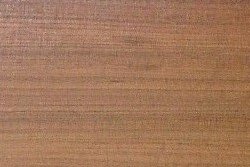
Mexican Granadillo
Platymiscium yucatanum
Fretboard
Guitar body
Mexican Granadillo
OriginCentral America
DescriptionDensity 800-1000 kg/m³. Its characteristic reddish-brown colour.
PropertiesStore somewhere free from sudden temperature changes.
UseFretboards, guitar bodies, castanets and marimba bars.
See full details →

↻
Hard Maple
Acer saccharum
Necks
Hard Maple
OriginNorth America
DescriptionA pale wood with a density of 630-700 kg/m³.
PropertiesTough to saw, tricky to machine, and a real challenge to sand.
UseMainly used for electric guitar and bass necks.
See full details →

↻
Beech
Fagus sylvatica
Turning
Knife handles
Beech
OriginEurope
DescriptionDensity 710 kg/m³. A pale-toned wood with even grain.
PropertiesExcellent workability. Suited to turning and steam-bending into curved parts.
UseGreat for turning and knife handles.
See full details →
↻
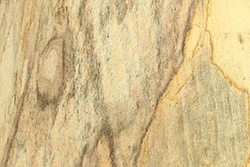
Spalted Beech
Fagus sylvatica
Turning
Spalted
Spalted Beech
OriginEurope
DescriptionDensity 710 kg/m³. Decorative black streaks created by fungi acting on the wood.
PropertiesTricky to dry, with a risk of warping and uneven colouring.
UseGreat for turning and knife handles.
See full details →

↻
Hickory
Carya alba
Percussion
Drumsticks
Hickory
OriginUnited States
DescriptionDensity 790-830 kg/m³. A pale wood with high impact resistance.
PropertiesCan stain in humid environments.
UseDrumsticks for percussion instruments (drum kit, snare).
See full details →

↻
Katalox
Swartzia cubensis
Fretboard
Bridge
Katalox
OriginCentral and South America
DescriptionDensity 1150 kg/m³. Heartwood is a reddish brown that's almost black.
PropertiesTough to work and plane because of its hardness.
UseFretboards and bridges, interior joinery, cabinetmaking.
See full details →
↻
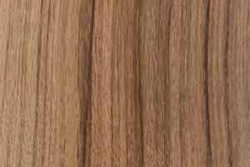
Indian Laurel
Terminalia tomentosa
Fretboard
Back and sides
Indian Laurel
OriginIndia
DescriptionLight to dark brown with near-black streaks.
PropertiesWorks well overall. Watch out when planing the interlocked grain.
UseFretboards and bodies for classical and acoustic guitar.
See full details →
↻
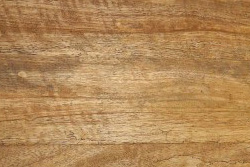
Limba
Terminalia superba
Electric guitar body
Neck
Limba
OriginCentral Africa
DescriptionDensity 600 kg/m³. Pearly cream-white that darkens with light exposure. Known as Korina in the lutherie world.
PropertiesWorks well, machines cleanly, and takes finish beautifully.
UseElectric guitar bodies and necks (Korina). Panels and cabinetmaking.
See full details →
↻
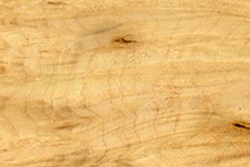
Big Leaf Maple
Acer saccharum
Electric guitar body
Burl
Big Leaf Maple
OriginNorth America
DescriptionDensity 630-700 kg/m³. A pale wood with straight grain and a fine texture.
PropertiesBends well under steam. Glues and finishes without trouble.
UseElectric guitar and bass bodies, turning and furniture.
See full details →
↻
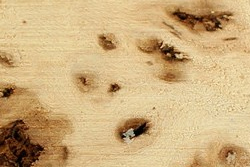
Poplar Burl
Populus nigra
Turning
Burl
Poplar Burl
OriginEurope
DescriptionDensity 480 kg/m³. A wood featuring the knots and eyes typical of burls.
PropertiesSoft and easy to turn. Stabilise the voids with epoxy before machining.
UseGreat for turning and for resin-filled work in the burl's eyes.
See full details →
↻
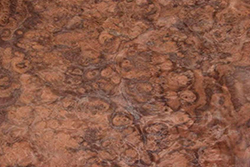
Walnut Burl
Juglans nigra
Electric guitar body
Burl
Walnut Burl
OriginUnited States and Canada
DescriptionDensity 550-660 kg/m³. Eyes of varying sizes that give it serious visual appeal.
PropertiesSlow drying in a dry spot to keep defects at bay.
UseElectric guitar bodies and drop tops, turning and high-end cabinetmaking.
See full details →
↻
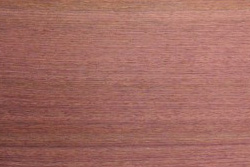
Macacauba
Platymiscium spp.
Fretboard
Guitar body
Macacauba
OriginCentral and South America
DescriptionDensity 950 kg/m³. A sister species to Mexican Granadillo (same genus).
PropertiesWorks well by hand and by machine.
UseFurniture, veneer, musical instruments and specialised small woodwork.
See full details →
↻
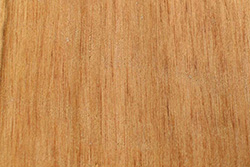
Apple
Malus domestica
Turning
Knife handles
Apple
OriginEurope
DescriptionDensity 830 kg/m³. A fruitwood with fine grain and medium-to-high hardness.
PropertiesA bit demanding to work due to its high density.
UseCarving, turning, tool handles and specialised small objects.
See full details →

↻
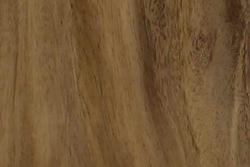
Ovangkol
Guibourtia ehie
Back and sides
Acoustic
Ovangkol
OriginGabon
DescriptionDensity 725-820 kg/m³. Greenish tones with black streaks. Look-and-feel close to rosewood.
PropertiesWatch out for the interlocked grain.
UseBack and sides for acoustic and classical guitar.
See full details →
↻
Monkey Pod
Samanea saman
Back and sides
Acoustic
Monkey Pod
OriginSouth America
DescriptionDensity 600 kg/m³. Light brown with the occasional darker streak.
PropertiesWorks well. Interlocked grain can splinter — keep tools sharp.
UseBack and sides for acoustic guitar and ukulele.
See full details →
↻
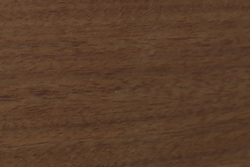
Mopane
Colophospermum mopane
Woodwind
Turning
Mopane
OriginAfrica
DescriptionA dark brown wood with a density of 1075 kg/m³.
PropertiesVery dense, with excellent tonal qualities.
UseTurning, carving and woodwind instruments (clarinet, oboe).
See full details →
↻
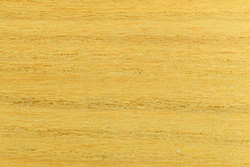
Mulberry
Morus alba
Turning
Furniture
Mulberry
OriginEurope
DescriptionDensity 690 kg/m³. A golden-yellow wood that darkens over time to amber tones.
PropertiesBehaves well with both hand tools and machinery.
UseTurning, fence posts and furniture.
See full details →
↻
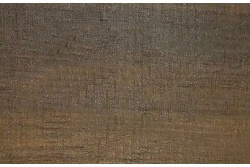
Musutaiba
Dalbergia elegans
Back and sides
Acoustic
Musutaiba
OriginBrazil
DescriptionDensity 920 kg/m³. A Brazilian rosewood, sister species to Brazilian Jacaranda da Bahia.
PropertiesDense but workable. Gluing needs some prep due to its oily nature.
UseBack and sides for acoustic and classical guitar.
See full details →
↻
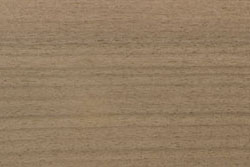
American Walnut
Juglans nigra
Back and sides
Acoustic
American Walnut
OriginUnited States
DescriptionDensity 550-660 kg/m³. Chocolate brown. A solid alternative to mahogany and rosewood.
PropertiesWorks well. Machines cleanly. Strong tonal qualities.
UseBack and sides for acoustic and classical guitar.
See full details →
↻
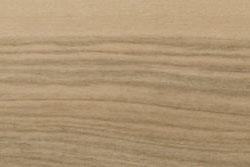
European Walnut
Juglans regia
Back and sides
Classical
European Walnut
OriginSpain
DescriptionDensity 700-780 kg/m³. Various shades of brown. A historic wood in the Spanish classical guitar tradition.
PropertiesHand-tools beautifully. Glues cleanly and takes oil finishes wonderfully.
UseBack and sides for classical and acoustic guitar.
See full details →
↻
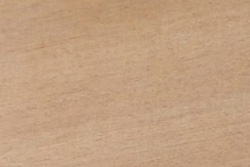
Okoume
Aucoumea klaineana
Electric guitar body
Veneers
Okoume
OriginCentral Africa
DescriptionDensity 450 kg/m³. A lightweight, mahogany-like wood at an affordable price. Also spelled Okoumé.
PropertiesEasy to saw. Blade dulling ranges from normal to fast.
UseVeneers, marine plywood, joinery and electric guitar bodies.
See full details →
↻
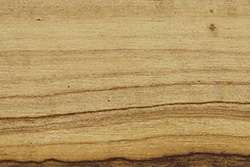
Olive
Olea europaea
Turning
Inlay
Olive
OriginOriginally from the Middle East (Syria and Anatolia)
DescriptionDensity 850-1120 kg/m³. Mediterranean olive, one of the densest woods in Europe.
PropertiesBest to start kiln drying at very low temperatures.
UseCarving, turning, inlay, knife handles and decorative work.
See full details →

↻
Elm
Ulmus minor
Turning
Elm
OriginCentral and Southern Europe
DescriptionIt has a density of 630-680 kg/m³.
PropertiesEasy to work, hard to split, and highly rot-resistant as long as it stays damp.
UseTurning, boatbuilding and mining construction.
See full details →

↻
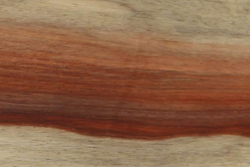
Padauk
Pterocarpus tinctorius
Back and sides
Xylophone
Padauk
OriginGabon
DescriptionA reddish-toned wood with a density of 825 kg/m³.
PropertiesHard, stable and tough.
UseGuitar back and sides, xylophone and marimba bars.
See full details →
↻
Padauk Bariolé
Pterocarpus soyauxii
Back and sides
Turning
Padauk Bariolé
OriginAfrica
DescriptionA deep red wood with pale streaks and a density of 825 kg/m³.
PropertiesStable and tough. Striking aesthetic qualities.
UseGuitar back and sides, and turning.
See full details →

↻
Tulipwood
Dalbergia frutescens
Woodwind
Clarinet
Tulipwood
OriginBrazil
DescriptionA wood with pink streaks and a density of 1010-1040 kg/m³.
PropertiesVery dense. Prized for both its tonal and aesthetic qualities.
UseWoodwind instruments (clarinet, oboe, flute).
See full details →
↻
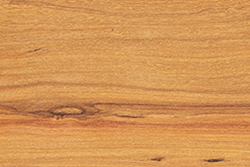
Mozambique Pau Rosa
Swartzia fistuloides
Back and sides
Acoustic
Mozambique Pau Rosa
OriginMozambique
DescriptionA wood with pink streaks and a density of 1100 kg/m³.
PropertiesVery hard and lustrous. Open-pored — use grain filler before the final finish.
UseBack and sides for acoustic and classical guitar.
See full details →

↻
Amazon Rosewood
Dalbergia spruceana
Back and sides
Xylophone
Amazon Rosewood
OriginBrazil
DescriptionA dark brown wood with a density of 1100 kg/m³.
PropertiesDense and oily. Gluing needs some prep — keep your tools sharp. Exceptional tonal qualities.
UseGuitar back and sides, and xylophone bars.
See full details →

↻
Honduras Rosewood
Dalbergia stevensonii
Xylophone
Back and sides
Honduras Rosewood
OriginGuatemala
DescriptionA light brown wood with a density of 1070 kg/m³.
PropertiesDense and oily. Gluing needs some prep — keep your tools sharp. Exceptional tonal qualities.
UseMarimba/xylophone bars and guitar back and sides.
See full details →
↻
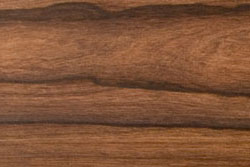
Madagascar Rosewood
Dalbergia baronii
Back and sides
Fretboard
Madagascar Rosewood
OriginMadagascar
DescriptionA brown wood with dark figure and a density of 920 kg/m³.
PropertiesCracks easily — handle with care when bending.
UseAcoustic back and sides, electric guitar fretboard.
See full details →

↻
Indian Rosewood
Dalbergia latifolia
Back and sides
Fretboard
Indian Rosewood
OriginIndia
DescriptionDensity 870-900 kg/m³. The most widely used rosewood in lutherie. Brown, pink and violet tones.
PropertiesHugely popular thanks to its all-round qualities.
UseBack, sides, fretboard, bridge, headstock and binding. Electric/bass fretboard.
See full details →
↻
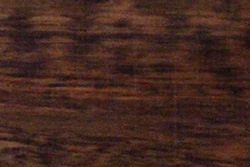
Snakewood
Piratinera guianensis
Turning
Snakewood
OriginSouth America
DescriptionDensity 1210 kg/m³. Snakewood: characteristic black hieroglyph-like markings.
PropertiesVery dense — dulls tools quickly. Take small cuts and keep your edges sharp.
UseGreat for turning and small decorative pieces.
See full details →
↻
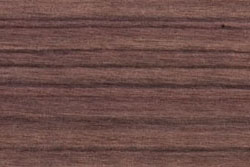
Kingwood
Dalbergia cearensis
Fretboard
Woodwind
Kingwood
OriginBrazil
DescriptionA wood with various shades of brown and dark figure, density 1020 kg/m³.
PropertiesDense and oily. Great quality-to-price ratio.
UseGuitar fretboard, bridge and headstock. Electric guitar and bass fretboard.
See full details →
↻
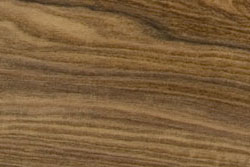
Santos Rosewood
Machaerium scleroxylon
Fretboard
Bridge
Santos Rosewood
OriginBrazil
DescriptionA wood with various shades of brown and dark figure, density 940 kg/m³.
PropertiesGreat quality-to-price ratio.
UseGuitar fretboard, bridge and headstock. Electric guitar and bass fretboard only.
See full details →

↻
Pear
Pyrus communis
Turning
Carving
Pear
OriginEurope
DescriptionA very popular wood across Europe, with a density of 690 kg/m³.
PropertiesGenerally easy to work with both hand tools and machinery.
UseUsed for both turning and carving.
See full details →

↻
Purpleheart
Peltogyne pubescens
Electric guitar body
Furniture
Purpleheart
OriginCentral America
DescriptionA violet-coloured wood with a density of 880 kg/m³.
PropertiesTends to darken with air exposure. Easy to saw, but you'll need powerful machinery and blades dull quickly.
UseMusical instruments, flooring, furniture, boatbuilding and specialised items.
See full details →
↻
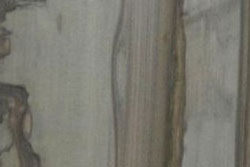
Red Gum
Liquidambar styraciflua
Electric guitar body
Red Gum
OriginUSA
DescriptionDensity 560 kg/m³.
PropertiesWorks well. Characteristic mottled figure.
UseElectric guitar bodies, veneers and furniture.
See full details →
↻
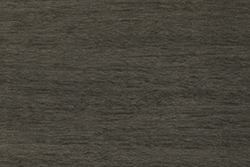
Royal Blackwood
Peltogyne catingae
Back and sides
Fretboard
Royal Blackwood
OriginBrazil
DescriptionAn amaranth variety put through a patented torrefaction process. Density 900-1000 kg/m³.
PropertiesThe only wood that's naturally uniform black throughout — not even ebony is this homogeneous.
UseGuitar back and sides, fretboards.
See full details →
↻
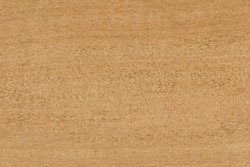
African Mahogany
Khaya spp.
Neck
Electric guitar body
African Mahogany
OriginCameroon
DescriptionA light-coloured wood with a density of 420 kg/m³.
PropertiesReadily available and affordable.
UseNeck and body for classical and acoustic guitar. Body for electric guitar and bass.
See full details →
↻
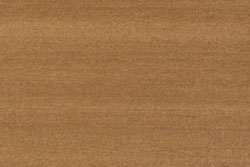
Sapele
Entandrophragma cylindricum
Back and sides
Acoustic
Sapele
OriginGabon
DescriptionA brown-coloured wood with a density of 560 kg/m³.
PropertiesFinishes beautifully. Affordable.
UseGuitar body.
See full details →
↻
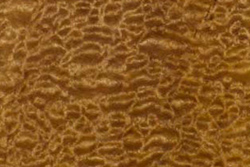
Quilted Sapele
Entandrophragma cylindricum
Back and sides
Quilted
Quilted Sapele
OriginCentral Africa
DescriptionA brown wood with a one-of-a-kind figure — a true rarity of nature. Density 950 kg/m³.
PropertiesStriking aesthetic qualities.
UseGuitar body.
See full details →
↻
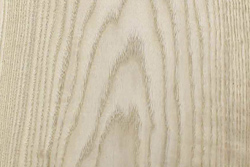
Sassafras
Sassafras albidum
Electric guitar body
Sassafras
OriginNorth America
DescriptionA wood that resembles swamp ash, with a density of 495 kg/m³.
PropertiesTonal qualities similar to ash.
UseBodies for electric guitar.
See full details →
↻
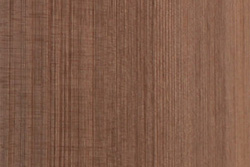
Redwood
Sequoia sempervirens
Turning
Redwood
OriginNorth American West Coast
DescriptionHeartwood ranges from light pinkish brown to deep reddish brown. Sapwood is pale white to yellow.
PropertiesEasy to work with both hand tools and machinery.
UseTurning, musical instruments and other small items.
See full details →
↻
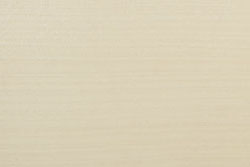
Sycamore
Acer pseudoplatanus
Back and sides
Acoustic
Sycamore
OriginGermany
DescriptionA white-coloured wood with a density of 620 kg/m³.
PropertiesCan stain in humid environments.
UseGuitar body and binding.
See full details →
↻
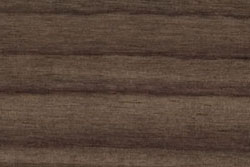
Sonokeling
Dalbergia latifolia
Fretboard
Bridge
Sonokeling
OriginIndonesia
DescriptionA wood with various tones — brown, pink and violet. Density 820 kg/m³.
PropertiesGreat quality-to-price ratio.
UseGuitar fretboard, bridge, headstock and binding. Electric guitar and bass fretboard.
See full details →

↻
European Lime
Tilia cordata
Electric guitar body
Bass
European Lime
OriginEurope
DescriptionA wood with a density of 520-560 kg/m³.
PropertiesEasy to work, though it tends to leave a bit of fuzz along the fibers.
UseMainly used for electric guitar and bass bodies and drop tops.
See full details →
↻
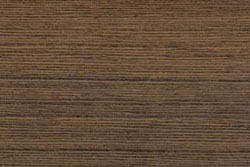
Wenge
Millettia laurentii
Fretboard
Bass
Wenge
OriginGabon
DescriptionA dark brown wood with a density of 780-900 kg/m³.
PropertiesSplinters easily.
UseElectric guitar and bass fretboard.
See full details →
↻
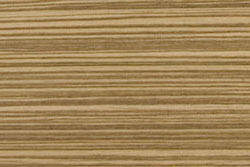
Zebrawood
Microberlinia brazzavillensis
Back and sides
Acoustic
Zebrawood
OriginGabon
DescriptionA light-coloured wood with dark streaks and a density of 550 kg/m³.
PropertiesStriking aesthetic qualities.
UseGuitar body.
See full details →
↻
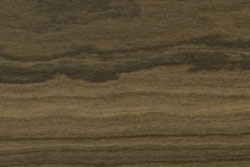
Ziricote
Cordia dodecandra
Back and sides
Acoustic
Ziricote
OriginMexico
DescriptionA green-toned wood with dark streaks.
PropertiesCracks easily.
UseGuitar body.
See full details →